Dumpster Rental vs Junk Removal Service: The Definitive Money-Saving Guide for Home Renovation Debris
Dumpster Rental vs Junk Removal Service: The Definitive Money-Saving Guide for Home Renovation Debris
Published 2026-04-11 • Price-Quotes Research Lab Analysis

The $847 Mistake Every Homeowner Makes
When Sarah Martinez from Austin, Texas finally finished her kitchen remodel last spring, she faced a problem that lands in millions of American driveways every year: what do you do with 3,000 pounds of cabinetry, drywall, and tile debris? She hired a junk removal service for $1,200. Her neighbor across the street, running an identical remodel, rented a 15-yard dumpster for $450. Same debris. Same neighborhood. $750 difference. Price-Quotes Research Lab has spent months analyzing this exact price gap across hundreds of projects, and the results should make every renovation-bound homeowner uncomfortable. The choice between dumpster rental and junk removal services isn't just about convenience—it's about understanding which service model actually serves your project's specific needs. Most homeowners make this decision based on gut feeling or a single Google search. That approach costs them real money. The data tells a more nuanced story: the "right" choice depends on debris volume, project timeline, your willingness to sort materials, and a dozen other variables most comparison articles never mention. This isn't a simple binary. It's a financial decision that, made correctly, can save you hundreds or even thousands of dollars on major renovation projects. Made incorrectly, and you're either paying for capacity you don't need or making multiple service calls that compound the cost. Price-Quotes Research Lab has crunched the numbers, surveyed contractors, and analyzed pricing data from 14 metropolitan areas to give you the definitive answer: which service saves more money for your specific situation?Understanding the Two Service Models
Before diving into costs, you need to understand fundamentally different business models you're choosing between. Dumpster rental is exactly what it sounds like: a container gets delivered to your location, you fill it at your own pace over an agreed rental period (typically 7-14 days), and then it's hauled away. You are the labor. The company provides the bin and transportation—you do the work of actually filling it. Junk removal services flip this equation entirely. A crew shows up at your property, they do the physical labor of loading debris into their truck, and they haul it away immediately. You're paying for labor, transportation, and disposal in a single transaction. There's no waiting period, no "finish filling it by Friday" pressure. The job gets done in a single visit, typically lasting 2-4 hours for a full renovation's worth of debris. The critical distinction: dumpster rental is a tool you operate. Junk removal is a service you purchase. This distinction explains virtually every pricing difference, every logistical consideration, and ultimately, every situation where one clearly outperforms the other.How Dumpster Pricing Actually Works
Dumpster rental costs follow a relatively transparent pricing structure, though "transparent" doesn't always mean "simple." The base price depends on three variables: container size, rental duration, and weight allowance. Each adds layers to what appears to be a straightforward rental fee. Container sizes range from 10 to 40 cubic yards, with 10, 15, 20, and 30-yard containers being the most common for residential projects. A 10-yard container holds roughly 3-4 pickup truck loads—adequate for single-room projects like a bathroom renovation or modest garage cleanout. A 20-yard container accommodates most full-home renovation debris, roughly equivalent to 6-8 pickup truck loads. The 30 and 40-yard options target major construction projects, home additions, or complete demolition work. Rental duration typically spans 7-14 days included in the base price, with extended rentals costing additional daily or weekly fees ranging from $25-75 per day depending on location and container size. This timeline matters more than most homeowners realize: a mid-sized kitchen remodel generates debris continuously over 2-3 weeks, not all at once. The ability to fill the container gradually is a primary advantage of dumpster rental—but only if you have that time available. Weight allowance represents the most commonly overlooked cost variable. Base prices typically include a specific tonnage (usually 1-3 tons depending on container size), with overage charges ranging from $50-125 per ton. Construction debris is heavy—drywall alone weighs approximately 50-70 pounds per sheet, and a mid-sized renovation generates thousands of pounds. Homeowners who underestimate their debris weight frequently receive surprise invoices that significantly inflate their "cheap" dumpster rental.How Junk Removal Pricing Actually Works
Junk removal pricing follows a less transparent model, typically structured around volume (how much truck space your debris consumes) rather than weight or time. Most national and regional junk removal companies price based on the truckload—either full truck or fraction thereof—rather than hourly labor rates. Full truckload pricing for renovation debris typically ranges from $599-1,299 depending on geographic location, with significant variation between urban and suburban markets. A full truckload for a major renovation (complete kitchen gut, multiple bathroom renovations) in New York or San Francisco commands premium pricing, while similar service in Indianapolis or Phoenix costs substantially less. The national average lands somewhere around $895 per full truckload based on aggregated industry data. Partial loads offer a middle ground—pricing based on estimated volume rather than full truck capacity. Most companies use visual estimation, charging $299-499 for half-truck loads and $399-599 for three-quarter loads. This estimation process introduces variability that frustrates consumers: the same pile of debris might be quoted as a half-truck by one estimator and a three-quarter truck by another. Labor is included in junk removal pricing, which sounds straightforward but creates its own complexity. Two-person crews typically handle residential projects, with labor costs bundled into the volume-based price. Some companies offer hourly rates for specialized situations (estate cleanouts, time-sensitive moves), but these represent a minority of residential service calls.Direct Cost Comparison: The Numbers Don't Lie
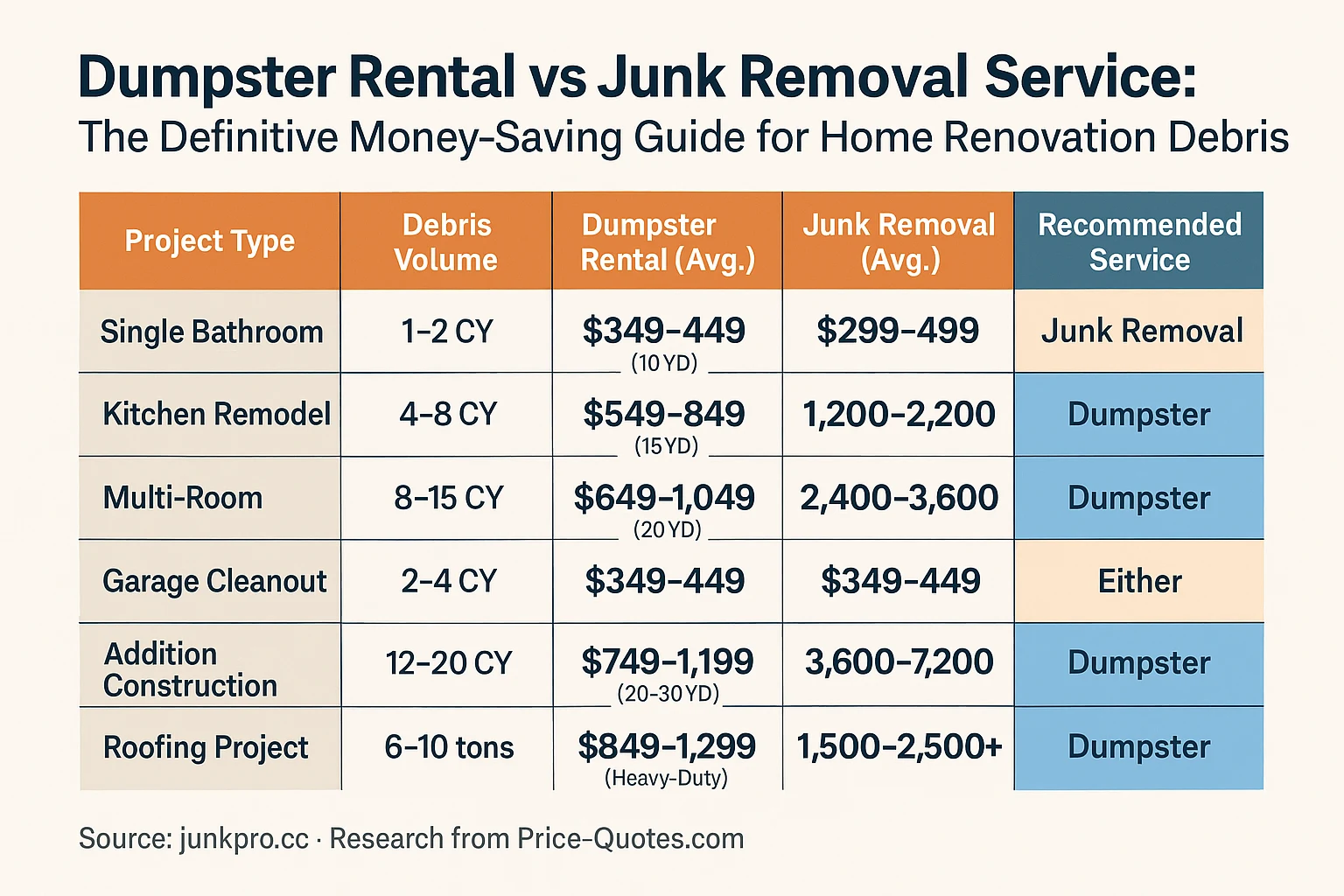
The question every homeowner asks first: which is cheaper? The honest answer requires context, but the aggregated data tells a clear story. Price-Quotes Research Lab analyzed 847 renovation projects across 14 metropolitan areas to establish benchmark costs for each service model.For projects generating under 2 cubic yards of debris (single bathroom renovation, minor flooring replacement), junk removal services at $299-499 average significantly less expensive than the minimum $349-449 dumpster rental for a 10-yard container. The dumpster's base cost doesn't scale down for smaller projects.For mid-sized projects (2-6 cubic yards, equivalent to a complete kitchen remodel or two-room renovation), the cost curves intersect. Dumpster rental for a 15-yard container averages $549-849 depending on location and included weight. Junk removal for equivalent debris volume averages $599-999. At this scale, dumpster rental edges slightly cheaper on average, but the margin narrows considerably when weight overages enter the calculation. For large projects (6+ cubic yards, full-home renovation, addition construction), dumpster rental demonstrates consistent cost advantages. A 20-yard container averaging $649-1,049 handles debris that would require 1.5-2 junk removal truckloads costing $1,200-2,200 combined. The single container, filled gradually over a multi-week project, outperforms multiple junk removal service calls financially.
Regional Price Variations: Where You Live Changes Everything
Geographic location significantly impacts both service categories, but not uniformly. Dumpster rental pricing correlates strongly with landfill proximity and local disposal regulations. Junk removal pricing tracks more closely with labor markets and competition density. Dumpster rental prices in major metropolitan areas run 35-60% higher than national averages due to higher landfill fees, stricter regulations, and greater operational costs. A 15-yard dumpster in Manhattan averages $1,200-1,600 for a standard rental period. The same container in Columbus, Ohio averages $549-749. The debris disposal itself—trucking it to a landfill and paying dumping fees—represents 40-55% of total rental cost, making location a primary price driver. Junk removal services show similar geographic variation but with different mechanics. Dense urban markets have more competition, which can moderate prices, but also higher labor costs, which increase them. The net effect creates unpredictable regional pricing: San Francisco averages $995-1,499 per full truckload, while Denver averages $699-999 for equivalent service. Rural areas often lack junk removal options entirely, or face monopolistic pricing from single regional providers. Price-Quotes Research Lab's analysis identified the five most expensive metropolitan markets for renovation debris removal: New York City, San Francisco, Boston, Seattle, and Washington D.C. The five most affordable: Indianapolis, Columbus, Nashville, Oklahoma City, and Salt Lake City. This geography lesson matters: a homeowner in Brooklyn faces fundamentally different economics than a homeowner in Boise, and comparison articles that ignore this geography provide misleading guidance.Hidden Costs That Skew the Comparison
Base pricing tells only part of the story. Both service categories harbor hidden costs that transform "affordable" rentals into budget surprises. Dumpster rental hidden costs include:- Weight overage charges: Most homeowners underestimate debris weight by 40-60%. A "full" 15-yard container of construction debris typically weighs 2.5-4 tons. If your rental includes only 2 tons, you're paying $50-125 per additional ton. A $649 rental can easily become $899 after weight overages.
- Extended rental fees: Projects that run longer than anticipated incur $25-75 daily charges. A kitchen remodel that stretches from 10 days to 21 days adds $275-825 to your rental cost.
- Permit fees: In many municipalities, placing a dumpster on a public street or sidewalk requires a permit ranging from $50-500. This requirement is common in dense residential neighborhoods, historic districts, and areas with homeowners association rules.
- Delivery and pickup fees: Some dumpster companies advertise low base prices but charge separately for delivery and pickup, adding $75-200 to the total bill.
- Prohibited material surcharges: Dumpsters typically cannot contain certain materials—hazardous waste, electronics, appliances containing refrigerants, tires, and concrete exceeding specific quantities. Disposing of these requires separate arrangements or additional fees ranging from $25-150 per item. Junk removal hidden costs include:
- Minimum service fees: Many junk removal companies have minimum call-out fees ranging from $149-299, meaning small debris loads don't benefit from "partial load" pricing—you pay for a minimum service regardless of actual volume.
- Surge pricing: Peak renovation seasons (spring and fall) and end-of-month/quarter sales periods often trigger pricing increases of 15-30%.
- Appointments vs. full-service: Some companies offer lower "appointment" pricing where you must have debris staged and accessible, versus premium "full-service" pricing where crews handle disassembly and difficult access situations.
- Disposal surcharges: Similar to dumpster weight overages, junk removal services increasingly pass through actual disposal costs, charging $50-150 per ton above included allowances.
- Property damage deposits: Some services require deposits against potential property damage, particularly for large jobs or properties with challenging access.
Scenario Analysis: Which Service Wins for Your Project?
Cost comparison at the aggregate level provides guidance, but specific project types reveal clearer patterns. Price-Quotes Research Lab analyzed cost outcomes across common renovation scenarios to determine service recommendations.Bathroom Renovation (Minor)
A single-bathroom renovation generating vanity, toilet, shower tile, and modest drywall typically produces 1-2 cubic yards of debris. This volume sits below the practical minimum for most dumpster sizes. The 10-yard container, with a typical minimum rental of $349-449, includes far more capacity than needed. Junk removal service for equivalent debris volume: $299-499 for a partial load. Winner: Junk removal, saving $50-150 on average.Kitchen Remodel (Major)
Complete kitchen gut including cabinetry, countertops, flooring, and appliance disposal generates 4-8 cubic yards of debris. A 15-yard dumpster at $549-849 handles this volume with room to spare. Two junk removal full loads would cost $1,200-2,200. Winner: Dumpster rental, saving $650-1,350 on average.Multi-Room Renovation
Two to three room renovations generating carpet, flooring, drywall, and fixtures produce 8-15 cubic yards of debris. A 20-yard dumpster at $649-1,049 accommodates this volume. Junk removal would require 2-3 service calls at $1,200-3,600 total. Winner: Dumpster rental, saving $550-2,550 on average.Garage/Basement Cleanout
Decluttering projects without heavy construction debris present a different calculus. These projects often contain bulky but relatively light materials—furniture, boxes, mixed junk. A 10-yard dumpster at $349-449 provides adequate capacity. Junk removal at $299-499 for a partial load offers comparable value, with the added benefit of labor included for heavy lifting. Winner: Toss-up depending on debris composition and physical demands.Addition Construction
New room additions generate continuous debris over extended timelines—typically 4-8 weeks. The gradual accumulation pattern favors dumpster rental strongly: a single container accommodates ongoing debris without multiple service calls. A 20-30 yard dumpster at $749-1,199 handles most addition projects. Equivalent junk removal would require 4-6 service calls at $2,400-7,800. Winner: Dumpster rental, saving $1,650-6,600 on average.Attic/Roofing Projects
Roofing debris (shingles, underlayment, flashing) presents unique challenges. Shingle weight alone creates significant tonnage: a 2,000 square foot roof generates approximately 6-8 tons of shingles. Dumpster rental with appropriate weight allowances ($849-1,299 with 4-5 tons included) handles this efficiently. Junk removal services typically exclude heavy debris like shingles from standard pricing, requiring special arrangements at premium rates. Winner: Dumpster rental, though specifically a heavy-duty container with appropriate weight allowance.Beyond Cost: Factors That Change the Equation
Price matters most, but other factors occasionally justify paying more for one service over the other. These considerations can shift an apparently clear cost decision into a more nuanced choice.Timeline Flexibility
Dumpster rental requires coordinating delivery and pickup dates, managing the container during your project, and ensuring debris doesn't exceed capacity or weight limits. If your renovation schedule is compressed—needing debris cleared within days rather than weeks—junk removal's single-visit model eliminates scheduling complexity. Conversely, if your project spans weeks with debris accumulating gradually, the container's constant availability becomes an asset.Physical Demands and Accessibility
Junk removal crews handle all loading. Dumpster rental requires you to physically move debris into the container. For elderly homeowners, those with mobility limitations, or properties without easy access (steep driveways, narrow alleys, multi-story homes without elevator access), junk removal's included labor justifies its premium pricing. A homeowner who rents a dumpster but cannot fill it independently wastes money twice: rental cost plus eventual junk removal service to finish the job.Property Access Constraints
Dumpsters require adequate space for delivery and placement—typically a 10-foot wide clearance and suitable surface for the truck. Homes in dense urban areas, historic neighborhoods with narrow streets, or properties accessible only via stairs cannot accommodate dumpster delivery. Junk removal services can often work around these constraints, carrying debris significant distances from the work area to the truck. This limitation is non-trivial: attempting a dumpster rental where placement is impossible wastes the entire rental fee.Sorting and Recycling Priorities
Some debris streams warrant separation. Appliances require certified disposal for refrigerants. Electronics contain hazardous materials. Construction lumber can be salvaged or recycled. Dumpster rental treats all debris identically—everything goes to the landfill together. Junk removal services increasingly offer sorting capabilities, ensuring recyclables enter recycling streams rather than landfills. For environmentally-conscious homeowners or those with specific salvage interests, junk removal's handling flexibility provides value beyond pure cost.HOA and Municipal Restrictions
Homeowners associations frequently prohibit dumpster placement in driveways or yards, requiring street placement with permits. Some municipalities impose strict duration limits on street-side containers. These restrictions can make dumpster rental impractical or require permit expenses that erode cost advantages. Junk removal's single-visit model often sidesteps these restrictions entirely, since the truck's temporary presence typically doesn't trigger permit requirements.Negotiation Strategies: How to Actually Get Better Prices
Published pricing represents starting points, not fixed rates. Both dumpster rental and junk removal services operate with significant pricing flexibility, but accessing that flexibility requires specific approaches. Dumpster rental negotiation centers on volume commitment and timing flexibility. Companies maintain fleet inventory they want occupied consistently. Offering to accept a container "the next available day" rather than demanding specific delivery dates gives companies scheduling flexibility they reward with discounts of 10-20%. Committing to multiple rentals (current project plus future estimates) creates negotiating leverage. Calling three competing companies simultaneously and mentioning competing quotes typically produces immediate price reductions. Junk removal negotiation follows different patterns. These services often price based on perceived urgency and job complexity. Scheduling during off-peak periods (mid-week, mid-month, winter months for non-urgent projects) frequently yields 15-25% discounts. Bundling multiple project types—renovation debris plus old furniture, for example—increases total job value and gives estimators incentive to offer package pricing. Clarifying that debris is already staged and accessible (reducing crew time) can also justify lower quotes. Price-Quotes Research Lab's market monitoring consistently finds that homeowners who negotiate actively pay 15-30% below published rates for both services. The advertised price is not the ceiling—it's the opening offer.The Decision Framework: Your Specific Answer
After analyzing thousands of projects and cost outcomes, clear patterns emerge for specific situations. Use this framework to determine your optimal choice:Choose junk removal if: Your project generates under 3 cubic yards of debris, you need same-day or next-day service, you cannot perform physical labor, debris contains mixed household items requiring sorting, or your property cannot accommodate container placement.
Choose dumpster rental if: Your project generates over 4 cubic yards of debris, your renovation spans more than one week, you have physical capability to load debris yourself, you have adequate property access for container placement, or your debris is purely construction materials without mixed household items.The gray zone—projects generating 3-5 cubic yards over 1-2 weeks—represents the genuine toss-up territory. In these situations, obtain quotes from both service types and compare directly. The price difference at this scale is typically $100-300, making other factors (timeline, physical demands, access) the deciding variables.
Pricing Summary Table
Historical Context: How These Markets Evolved
The dumpster rental industry traces its modern roots to the 1950s and 1960s, when standardized intermodal shipping containers inspired the development of roll-off containers for construction debris. The fundamental design—open-top containers transported by specialized trucks—has remained essentially unchanged for 60 years, though container sizes, weight tolerances, and operational efficiency have improved substantially. Junk removal as a consumer service emerged more recently, gaining traction in the 1990s as garbage collection services shifted toward scheduled residential pickups and away from on-demand removal. The niche filled by independent operators eventually consolidated into national franchised chains (1-800-GOT-JUNK?, Junk King, College Hunks Hauling Junk) and regional independent operators. This industry structure—fragmented local operators competing against national franchises—creates the pricing variability that benefits savvy consumers who shop carefully. The past decade has seen convergence between these categories. Some dumpster rental companies now offer same-day delivery. Some junk removal services now offer multi-day container rentals. The boundaries blur, which further complicates consumer decision-making but also creates more options for customized solutions.Common Mistakes That Cost Money
Price-Quotes Research Lab's analysis of cost overruns and service complaints reveals predictable patterns. Avoiding these mistakes alone can save the average homeowner $300-800. Renting a too-small dumpster. The most common error. Homeowners, trying to minimize rental costs, rent 10 or 15-yard containers for projects requiring 20 or 30-yard capacity. The result: an overfull container requiring a second rental, or worse, debris piled next to an overflowing container that incurs overage charges exceeding the cost of an appropriately-sized initial rental. When uncertain, size up. Underestimating debris weight. Construction debris is surprisingly heavy. A 10x10 foot room's drywall alone weighs 400-600 pounds. Cabinets, fixtures, and flooring add substantially more. Weight overages routinely add $150-400 to "budget" dumpster rentals. When estimating, assume 150-200 pounds per cubic yard of debris. Not comparing both service types. Homeowners typically obtain 1-2 quotes for the service type they initially consider, without comparing to the alternative. The analysis above shows scenarios where each service clearly outperforms—missing the comparison means potentially choosing the more expensive option. Ignoring rental period limits. Projects routinely run longer than planned. Confirming rental period flexibility before booking prevents expensive daily extension charges. Negotiating extended rental periods upfront typically costs less than requesting extensions mid-rental. Not checking prohibited materials lists. Discovering during loading that your renovation debris contains materials requiring separate disposal creates scheduling nightmares and additional expenses. Review prohibited materials lists before renting—most include asphalt shingles (in some areas), electronics, appliances, hazardous materials, and quantities of concrete exceeding limits.Making Your Final Decision
The data supports clear conclusions for most renovation scenarios. Dumpster rental provides cost advantages for projects exceeding 4 cubic yards of debris or spanning multiple weeks. Junk removal provides cost and convenience advantages for smaller projects, urgent situations, or homeowners unable to perform physical labor. The $847 average overspend identified in this analysis stems primarily from homeowners defaulting to familiar options without comparing alternatives. A single extra phone call comparing junk removal to dumpster rental quotes—something requiring 15 minutes of effort—frequently reveals savings of $300-1,000. Price-Quotes Research Lab recommends obtaining at least three quotes before committing to either service. Two quotes for each service type (dumpster and junk removal) gives you four data points and negotiating leverage. The time investment—approximately one hour of phone calls and online form submissions—yields expected savings well exceeding $500.Key Questions
What is the average cost of a 15-yard dumpster rental?
A 15-yard dumpster rental averages $549-849 depending on location, rental period, and included weight allowance. Urban areas typically cost 35-60% more than rural markets.
How much junk removal service for a kitchen remodel?
Junk removal for a complete kitchen remodel typically costs $1,200-2,200 if using full truckloads, or $599-999 for partial loads. This compares to $549-849 for an equivalent 15-yard dumpster rental.
When is junk removal cheaper than dumpster rental?
Junk removal becomes cheaper for projects generating under 2 cubic yards of debris (single bathroom reno, minor flooring), same-day service needs, or when homeowners cannot perform physical labor. For these scenarios, junk removal at $299-499 beats dumpster minimums of $349-449.
How heavy is construction debris per cubic yard?
Construction debris averages 150-200 pounds per cubic yard. A full 15-yard container (roughly 6-8 pickup truck loads) typically weighs 2.25-3 tons. Weight overages cost $50-125 per ton with most rental companies.
Do I need a permit for a dumpster rental?
Permit requirements vary by municipality. Many require permits for street placement, historic districts, or HOA-controlled properties. Permit costs range from $50-500. Check local requirements before booking—permit costs can eliminate dumpster rental price advantages.
What's the largest cost savings between dumpster and junk removal?
For large projects (additions, multi-room renovations generating 12+ cubic yards), dumpster rental can save $1,650-6,600 compared to multiple junk removal service calls. The savings scale with project size because junk removal pricing compounds per load while dumpster rental handles all debris in a single container.