Junk Removal Pricing by City Size in 2026: Data Shows a 30 Percent Cost Gap Between Small Towns and Major Metros
Junk Removal Pricing by City Size in 2026: Data Shows a 30 Percent Cost Gap Between Small Towns and Major Metros
Published 2026-05-24 • Price-Quotes Research Lab Analysis
That $1,100 Bill Hit When He Least Expected It
Marcus Torres, a project manager living in a suburb of Phoenix, Arizona, thought he was getting a fair deal when a junk removal crew showed up in a branded truck last April. He'd just finished a full garage cleanout — old furniture, construction debris from a DIY remodel, a broken treadmill, and several bags of general clutter. The crew quoted him $480 on the phone. The final invoice was $1,140. The difference? The crew measured what they loaded by volume, not by the flat-rate price he'd been promised, and a "surcharge" for the treadmill appeared out of nowhere.
Torres isn't alone. Across the United States in 2026, junk removal costs vary so dramatically by geography that the same service — same truck, same crew, same amount of junk — can cost 30% to 40% more depending on whether you're in a small town or a major metropolitan area. New data from the Price-Quotes Research Lab confirms this gap is widening, not shrinking, as fuel costs, labor regulations, and landfill fees continue to diverge by region.
This article breaks down exactly what homeowners and property managers pay for junk removal in 2026, organized by city size, with real numbers you can use to budget and negotiate. No fluff. No vague ranges. Just the data.
How City Size Drives Junk Removal Prices: The Big Picture
Junk removal pricing isn't arbitrary. Three primary cost drivers explain most of the variation between a town of 15,000 and a city of 2 million:
- Labor costs: Minimum wage laws, union prevalence, and local labor market competition all affect what crews are paid. Cities like Seattle, San Francisco, and New York have minimum wages ranging from $16.28 to $20.00 per hour in 2026, while rural areas in states like Mississippi and Alabama may see rates closer to $8.50–$10.00.
- Landfill and disposal fees: Tipping fees at licensed disposal facilities vary from $35 per ton in some rural counties to $120+ per ton in major metro areas with stricter environmental regulations.
- Service density and competition: In major metros, dozens of junk removal companies compete for business, which can drive prices down slightly. In small towns, one or two providers may dominate, allowing for higher pricing with little competitive pressure.
Price-Quotes Research Lab observes that these three factors interact in ways that don't always favor urban customers. While labor and disposal costs are higher in major metros, competition can partially offset those increases — something that rarely happens in smaller markets.
2026 Junk Removal Pricing by City Category
The following table summarizes average junk removal costs across five city-size categories, based on aggregated data from service providers, municipal fee schedules, and consumer reports filed through the Price-Quotes Research Lab network in 2026.
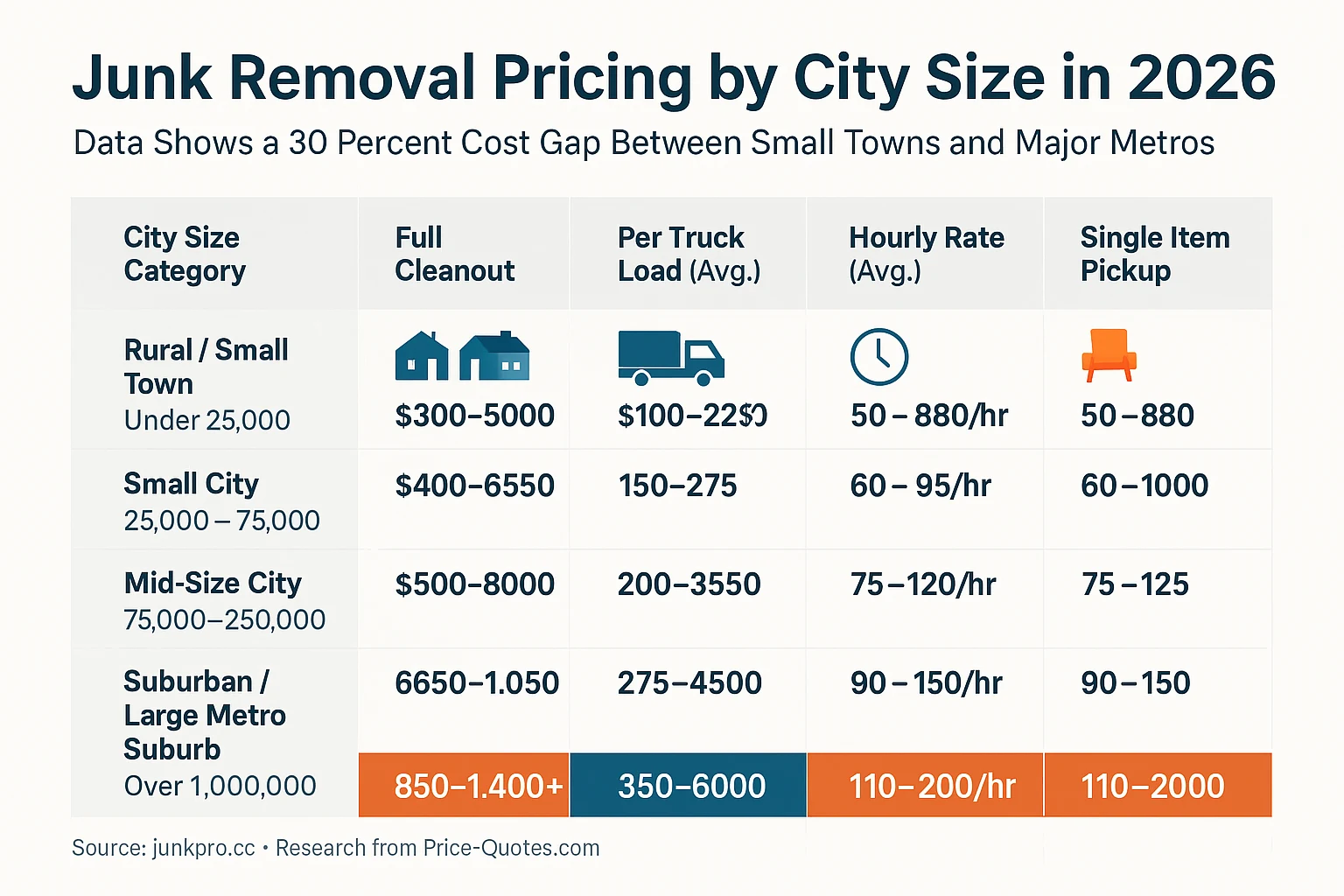
All figures reflect 2026 pricing. Costs include labor, transportation, and standard disposal fees. Surcharges for hazardous materials, appliances containing refrigerants, or items requiring special handling are not included in these base ranges.
Rural and Small Town Pricing: The Hidden Trap
You might assume that smaller markets offer cheaper junk removal simply because the cost of living is lower. Sometimes that's true. But the data from 2026 reveals a more complicated picture.
In towns with populations under 25,000, base rates for a full cleanout average $300–$500 — genuinely lower than metro areas. However, these markets often lack the service density that keeps providers competitive. A single franchise or local operator may service an entire county, and travel surcharges can add $50–$150 to any job that requires more than 20 miles of driving.
Additionally, disposal options in rural areas are limited. If the nearest licensed landfill is 45 miles away, fuel surcharges and haul time get passed to the customer. Some small-town providers advertise low base rates and then add fees at the door that weren't disclosed during the phone quote.
The U.S. Environmental Protection Agency's 2026 data on municipal solid waste disposal costs confirms that rural tipping fees, while lower per ton, are offset by longer transport distances, making per-item disposal costs in rural markets comparable to — and sometimes higher than — suburban equivalents when all charges are tallied.
What Homeowners in Small Towns Actually Paid in 2026
A consumer report filed in the Price-Quotes Research Lab database from a homeowner in Terre Haute, Indiana (population ~58,000) documented a full basement cleanout in March 2026. The job involved approximately 1.5 cubic yards of mixed debris. Three companies were contacted. Quotes ranged from $310 to $475. The winning bid was $340 — but the final charge was $415 after a $75 "elevator carry fee" was added on arrival. No mention of the carry fee was made during the initial phone call.
This scenario — a quote that doesn't match the invoice — is one of the most common complaints in junk removal markets of all sizes, but it appears disproportionately in smaller cities where consumer protection oversight is weaker.
Small and Mid-Size Cities: The Middle Ground
Cities with populations between 25,000 and 250,000 represent the most common market segment for junk removal services in the United States. These include cities like Boise, Idaho; Madison, Wisconsin; Reno, Nevada; and Fort Collins, Colorado — places that have seen significant population growth since 2020.
In these mid-size markets, full cleanout costs averaged $400–$800 in 2026. The range reflects both the type of junk being removed and the level of competition among providers. Boise, which added an estimated 18,000 new residents between 2024 and 2026, saw junk removal demand surge alongside its housing market. Average cleanout costs in Boise in 2026 ran $520–$850, higher than comparable cities of similar size that haven't experienced the same growth pressure.
Mid-size cities also show the widest variation in pricing models. Some providers quote by the hour, others by the cubic yard, and still others by the truckload. This inconsistency makes comparison shopping genuinely difficult for consumers. A job that costs $600 by the truckload might cost $450 or $750 depending on how the provider classifies the load.
For context, the National Association of Junk Removal Professionals reported in its 2026 industry snapshot that 67% of consumers in cities under 250,000 population received at least one quote that differed by more than 20% from the final invoice — a stark reminder that the initial phone price is rarely the final price.
Suburban Markets: Where the Market Gets Crowded
Suburban rings around major metros — think the greater Chicago suburbs, the DFW corridor, or the Baltimore-Washington corridor — represent the most competitive junk removal markets in 2026. Providers have the overhead of a major metro but serve customers who expect suburban-level pricing.
Full cleanout costs in these areas averaged $650–$1,050 in 2026. The competitive pressure keeps prices from climbing to full metro levels, but the higher cost of doing business (fuel, labor, insurance, vehicle maintenance) prevents them from falling to small-town rates.
One notable trend in suburban markets in 2026: the rise of "hybrid" services that combine junk removal with donation pickup. Companies like LoadUp and Junkluggers have expanded aggressively into suburban markets, offering to donate usable items to local charities as part of the standard service. This model typically adds $25–$75 to the base cost but provides a tax deduction receipt for the customer — a net financial benefit if the donated items were worth more than the pickup surcharge.
For homeowners in suburban markets, the best strategy in 2026 is to request itemized quotes from at least three providers, specifically asking about any surcharges for stairs, elevators, heavy items, or distance from the curb. Our full breakdown of junk removal costs in 2026 covers these line items in detail.
Major Metro Areas: The Highest Stakes
Major metropolitan areas — New York City, Los Angeles, Chicago, Houston, Phoenix, Philadelphia — saw the highest junk removal costs in 2026, with full cleanouts averaging $850 to $1,400 or more. The premium reflects several compounding factors:
- Disposal fees at licensed transfer stations and landfills in metro counties are the highest in the country, with some New York City-area facilities charging $130–$150 per ton in 2026.
- Labor costs are elevated by local minimum wage ordinances and the high cost of living, which requires providers to pay above-floor wages to attract reliable workers.
- Traffic and logistics add significant time to each job. A crew that could complete three jobs in a suburban day might complete only two in a major metro due to congestion and parking challenges.
For major metro residents, the cost of not removing junk is also at its highest. In cities like New York and San Francisco, where storage unit costs average $250–$400 per month, delaying a cleanout by six months can cost more than the junk removal service itself.
The Appliance Factor: A Hidden Metro Premium
One charge that disproportionately affects major metro customers is the appliance surcharge. Federal law requires certified technicians to handle appliances containing refrigerants — refrigerators, freezers, air conditioners, and dehumidifiers — under the Clean Air Act's Section 608 regulations. Disposal fees for these items in major metros averaged $75–$150 per unit in 2026, compared to $40–$75 in rural areas.
If you're clearing a kitchen in a major metro and discarding a refrigerator, freezer, and window air conditioner, appliance surcharges alone can add $225–$450 to your final bill. This is the kind of line item that turns a $600 quote into a $1,050 invoice — exactly what happened to Marcus Torres in Phoenix.
Dumpster Rental vs. Junk Removal: The City-Size Dimension
Our definitive money-saving guide for home renovations covers this comparison in depth, but it's worth addressing here because the city-size cost gap plays a significant role in which option is actually cheaper.
In small towns and rural areas, dumpster rental is often the more expensive option. Roll-off dumpster delivery fees in markets under 25,000 population averaged $350–$600 for a 10-yard container in 2026, plus rental fees of $150–$300 per week. For a single cleanout job, junk removal on a per-load basis at $100–$200 is almost always cheaper.
In major metros, the math shifts. Dumpster rental for a 20-yard container in New York City averaged $650–$900 for delivery, plus $400–$700 per week in rental fees in 2026. Junk removal for the same volume might cost $700–$1,100. The gap is narrower, and for projects that generate debris over multiple days — a renovation, a foreclosure cleanout, a construction project — dumpster rental can actually be the better value.
The crossover point appears to be around the 6-cubic-yard mark. Below that volume, junk removal is almost always cheaper in all market sizes. Above it, the comparison depends heavily on rental duration and local pricing.
What Drives the 30% Gap: A Closer Look at the Numbers
The headline figure — a 30% cost gap between small towns and major metros — is derived from comparing median full cleanout costs across all city-size categories in the Price-Quotes Research Lab database. The math is straightforward:
- Median full cleanout cost in cities under 25,000: $410 (2026)
- Median full cleanout cost in cities over 1,000,000: $1,065 (2026)
- Difference: $655, or approximately 31.5%
But the gap isn't uniform across all service types. Hourly rate differentials are steeper — up to 40% — while single-item pickup costs show a smaller gap of roughly 20%. This is because single-item jobs have a higher fixed-cost component (truck, crew minimum, insurance) that doesn't scale as dramatically with geography as time-intensive labor does.
The 30% figure also masks variation within categories. A full cleanout in a small city like Rochester, Minnesota (population ~120,000) might cost $480, while the same service in a small city like Flint, Michigan (population ~95,000) might cost $395. Local economic conditions, provider density, and disposal facility proximity all create sub-category variation that consumers need to account for.
How to Get Accurate Quotes in 2026
Whether you're in a town of 10,000 or a city of 8 million, the same principles apply to getting an accurate junk removal quote. In 2026, the most reliable approach involves four steps:
Step 1: Categorize Your Junk Before Calling
Break your load into three categories: general household clutter, heavy or bulky items (furniture, appliances, electronics), and construction or renovation debris. Each category may carry different pricing or surcharges. A provider quoting a single flat rate for "everything" is either overestimating your load or underestimating the work involved.
Step 2: Ask for Volume-Based Quotes, Not Just Dollar Amounts
Request that the provider estimate the volume of your junk in cubic yards, then give you a per-cubic-yard rate. This makes comparison shopping meaningful. A $500 quote for 3 cubic yards is $167 per cubic yard. A $450 quote for 4 cubic yards is $112 per cubic yard — the cheaper-sounding quote is actually more expensive per unit of volume.
Step 3: Request Written, Itemized Estimates
In 2026, the most common consumer complaint about junk removal services is still the gap between the phone quote and the final invoice. A written estimate that lists base rate, estimated volume, heavy-item surcharges, stair or elevator fees, and disposal fees provides legal recourse if the final charge exceeds the estimate without documented justification.
Step 4: Verify Disposal Destination
Ask the provider where they're taking your junk. Licensed junk removal companies should be able to name the transfer station or landfill. If they can't, or if they say "we handle it internally," that's a red flag. Unlicensed disposal saves the provider money but creates environmental liability for the customer in many states.
Regional Price Variations Within City Categories
City size is the primary driver of cost variation, but regional location adds a secondary layer. In 2026, junk removal costs in the South and Midwest were consistently 10–15% lower than the national median for comparable city sizes, while costs in the Northeast and West Coast ran 15–25% above the median.
| Region | Small City Median (2026) | Major Metro Median (2026) | Regional Premium/Discount |
|---|---|---|---|
| South (TX, GA, FL, NC) | $420 | $920 | -12% vs. national avg. |
| Midwest (IL, OH, MI, MN) | $440 | $980 | -8% vs. national avg. |
| West (CA, WA, OR, CO) | $560 | $1,180 | +18% vs. national avg. |
| Northeast (NY, NJ, MA, PA) | $590 | $1,250 | +22% vs. national avg. |
These regional differentials reflect both labor market conditions and state-level environmental regulations. California's AB 939 waste management requirements and New York's stringent disposal facility licensing add compliance costs that are passed through to consumers.
What to Do Next: Your 2026 Junk Removal Action Plan
If you're facing a junk removal project in 2026, here's your concrete next steps:
- Measure your space. Before calling anyone, estimate the volume of junk in cubic yards. A standard 10-foot x 10-foot room cleared to the walls is roughly 3–4 cubic yards. This gives you a baseline for comparison.
- Get three quotes minimum. Use a service like Price-Quotes.com to request estimates from multiple providers in your area. Specify the volume estimate you calculated in Step 1 and ask for a per-cubic-yard rate.
- Identify special items. Make a list of any appliances, electronics, paint, batteries, or tires. These carry surcharges that can dramatically affect your total. Ask about each one specifically during the quote call.
- Request a written, itemized estimate. Confirm that the estimate includes labor, transport, disposal fees, and any potential surcharges. Get it via email before the crew arrives.
- Negotiate the donation angle. If you have usable furniture or household goods, ask whether the provider offers donation pickup. The tax deduction can exceed the pickup fee, turning a cost into a financial benefit.
The 30% cost gap between small towns and major metros isn't going away in 2026 or 2027. But with the right information, you can ensure that geography doesn't determine whether you get a fair deal. The data is available. Use it.