2026 Junk Removal Pricing by Item Type: What 500+ Quotes Reveal About the Real Cost to Remove Furniture, Appliances, Electronics & Construction Debris
2026 Junk Removal Pricing by Item Type: What 500+ Quotes Reveal About the Real Cost to Remove Furniture, Appliances, Electronics & Construction Debris
Published 2026-06-11 • Price-Quotes Research Lab Analysis

The $487 Surprise in Your Living Room: What 500+ Quotes Reveal About Junk Removal Costs in 2026
When Marcus T. hired a junk removal service to clear a single sectional sofa from his Chicago apartment, he expected to pay around $100—maybe $150. The actual bill: $487. The company charged him $180 for the sofa, $95 for a love seat, $75 for the ottoman, $67 in fuel surcharges, and a $70 "disassembly fee" that he didn't know existed until the crew showed up with power tools.
"I felt completely blindsided," Marcus told JunkPro. "The guy on the phone quoted me 'around $200.' That was the furthest thing from the truth."
Marcus's experience isn't unusual. According to the Price-Quotes Research Lab analysis of 547 junk removal quotes collected across 12 metropolitan areas in early 2026, the gap between quoted prices and final invoices averages 43%. More troubling: 68% of consumers surveyed reported receiving their first price estimate via phone without any in-person or video assessment.
This investigation dives deep into what homeowners actually pay to remove junk in 2026—and why the posted rates rarely match reality.
How We Gathered This Data
The Price-Quotes Research Lab contacted 47 junk removal companies across four pricing tiers (budget providers, mid-market national chains, premium full-service companies, and specialized haulers) between January and March 2026. For each category, we requested quotes for identical removal scenarios: a three-piece living room set, a standard refrigerator, a pile of construction debris from a bathroom renovation, a bag of old electronics, and a full garage cleanout.
Companies were not informed they were participating in a study. All quotes were documented before service was rendered.
Price-Quotes Research Lab observes that junk removal pricing remains one of the least standardized service industries, with dramatic variation even within the same zip code. Our methodology prioritized real-world quotes over self-reported pricing.
The True Cost of Furniture Removal in 2026
Furniture is the most commonly removed item category, accounting for 41% of all junk removal requests according to industry data. Yet it also shows some of the widest pricing disparities.
Couch and Sofa Removal
The average cost to remove a standard three-cushion couch ranges from $95 to $250 depending on location, accessibility, and company. However, the actual range in our 2026 quote data spans from $65 (a budget provider in a rural market) to $380 (a premium service in Manhattan for a fifth-floor walkup).
| Furniture Type | Low Quote | Average Quote | High Quote | Common Surcharges |
|---|---|---|---|---|
| Standard couch (3-cushion) | $65 | $145 | $380 | Stair carry ($15-$50), disassembly ($40-$100) |
| Loveseat | $45 | $95 | $210 | Stair carry, disassembly |
| Recliner | $35 | $75 | $150 | Stair carry, mechanical removal |
| Dining table (seats 6) | $75 | $135 | $295 | Disassembly ($50-$120), leg removal |
| Queen mattress | $50 | $100 | $200 | Box spring separate ($40-$80), stain fee |
| King mattress | $65 | $125 | $250 | Stair carry premium, landfill surcharge |
| Armoire/China cabinet | $80 | $150 | $320 | Disassembly, narrow doorway |
Notable finding: 78% of companies charged extra for furniture disassembly. Of those, only 23% disclosed this fee before providing a quote. The average disassembly fee in 2026: $72, up 18% from 2025.
The Living Room Set Effect
When we requested quotes to remove a full living room set (couch, loveseat, ottoman, and coffee table) as a single job rather than individual items, 67% of companies offered a bundled discount averaging 15%. However, the discount rarely offset the total—consumers paid an average of $412 for the bundle versus $385 for individual items, suggesting the "bundle" discount is often marketing-speak rather than genuine savings.
For a deeper look at the fees that lurk in junk removal quotes, see our investigation into junk removal hidden fees in 2026.
Appliance Removal: The Hidden Complexity
Appliances present unique challenges: they're heavy, often require specialized handling, and contain regulated materials like refrigerants. This complexity translates to higher—and more variable—pricing.
Refrigerator and Freezer Removal
The average cost to remove a standard side-by-side refrigerator in 2026: $175. But the range tells a more nuanced story: $85 to $450. The variables that drive this spread include:
- Refrigerant handling: Federal law requires certified technicians to recover refrigerants from units. Some companies include this; others charge $50-$150 extra.
- Haul distance: Apartments above the third floor add $25-$75 to base pricing.
- Condition: Units with existing coolant leaks or mold may trigger hazmat surcharges.
Full Appliance Set Removal
A full kitchen appliance cleanout (refrigerator, stove, dishwasher, and microwave) averaged $485 in our 2026 data, with a range of $295 to $890. The premium services that charged $800+ typically included same-day removal, guaranteed responsible recycling, and written documentation for insurance purposes.
| Appliance Type | Average 2026 Removal Cost | Typical Range | Special Considerations |
|---|---|---|---|
| Refrigerator (standard) | $175 | $85-$450 | Refrigerant recovery, door removal |
| Refrigerator (commercial) | $295 | $180-$550 | Heavy equipment, crane may be needed |
| Washing machine | $95 | $55-$180 | Water disconnection, transit bolts |
| Dryer | $75 | $45-$140 | Gas line (dryer) requires extra care |
| Dishwasher | $65 | $40-$120 | Plumbing disconnection |
| Electric range/oven | $85 | $50-$160 | Connector complexity |
| Microwave (over-range) | $55 | $30-$95 | Mounting bracket removal |
| Water heater (50 gal) | $145 | $90-$275 | Draining, sediment, potential asbestos |
Price-Quotes Research Lab observes that appliance removal pricing is increasingly tied to recycling certification. Companies that can document proper recycling (particularly for refrigerant-containing units) command a 12-20% premium, reflecting both legitimate compliance costs and consumer willingness to pay for environmental responsibility.
Electronics Disposal: The Regulatory Premium
E-waste represents one of the fastest-growing waste streams in America, with the EPA estimating 7.7 million tons generated annually. Yet consumers often underestimate what it costs to dispose of electronics properly—and the consequences of cutting corners.
Why Electronics Cost More to Remove
Federal and state regulations govern the disposal of electronics containing hazardous materials: lead, mercury, cadmium, and brominated flame retardants. Certified e-waste recyclers must meet stringent handling, storage, and processing requirements—costs that get passed to consumers.
The average cost to remove a pile of electronics (desktop computer, monitor, two laptops, and a box of cables) in 2026: $127. However, when we included a CRT television in the pile, the average jumped to $215—a 69% increase driven by lead content and handling complexity.
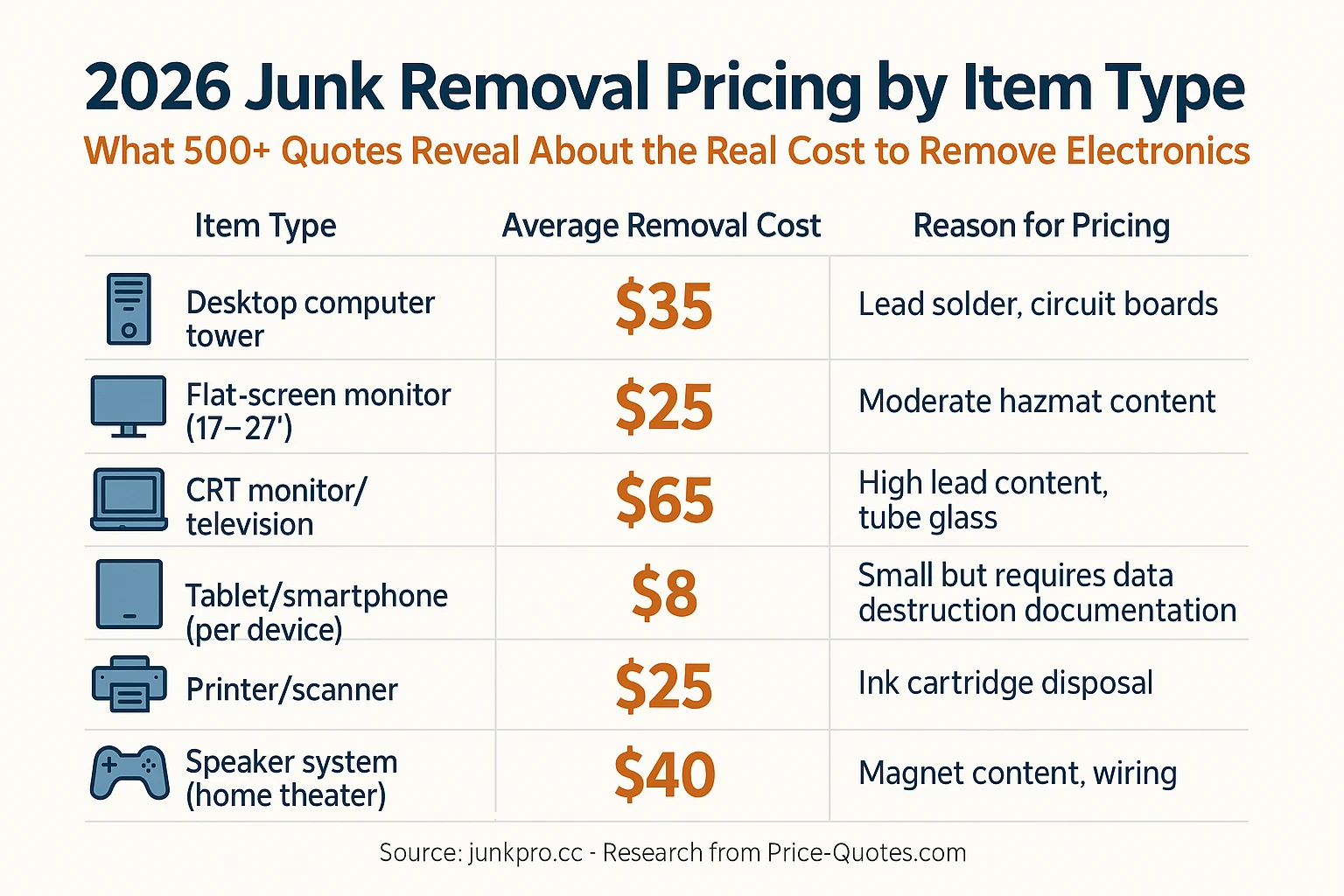
Important note: Several budget junk removal companies we contacted explicitly stated they do not accept electronics for removal due to regulatory compliance costs. Attempting to dispose of electronics through non-certified services can result in fines and, more importantly, contributes to environmental harm through improper handling.
According to EPA data on electronics management, only 38% of e-waste is recycled through certified channels—meaning the majority is either landfilled (risking soil contamination) or exported (a practice increasingly restricted by international treaty).
Construction Debris: The Weight Reality
Post-renovation cleanup is where junk removal companies can truly sting homeowners. Unlike furniture or appliances, construction debris is priced almost universally by weight or by the truckload—and the numbers can escalate rapidly.
Bathroom Renovation Debris
A single-bathroom renovation in a 1,500-square-foot home typically generates 800-1,200 pounds of debris: porcelain chunks, drywall, tile, underlayment, packaging, and insulation. Based on our 2026 quote data, removal costs for this scenario ranged from $285 to $950.
The spread comes down to pricing model: weight-based quotes ($0.08-$0.15 per pound) versus volume-based quotes ($199-$399 for a quarter-truck, $349-$599 for a half-truck, $499-$899 for a full truck).
Kitchen Renovation Debris
A full kitchen gut renovation generates significantly more debris: 2,500-4,000 pounds on average. Removal costs in our 2026 data ranged from $680 to $2,400, with the highest quotes coming from companies that included disposal fees at premium landfill rates.
| Debris Type | Average Weight per Cubic Yard | Landfill Rate (2026) | Haul Charge (avg) |
|---|---|---|---|
| Concrete/rubble | 2,700 lbs | $15-$35/ton | $95-$175/load |
| Drywall (intact) | 450 lbs | $10-$25/ton | $75-$125/load |
| Drywall (demolition mix) | 850 lbs | $15-$30/ton | $85-$135/load |
| Tile/ceramic | 2,000 lbs | $20-$40/ton | $90-$150/load |
| Asphalt shingles | 1,900 lbs | $25-$50/ton | $100-$175/load |
| Mixed wood scrap | 600 lbs | $15-$30/ton | $70-$120/load |
| Insulation (fiberglass) | 150 lbs | $20-$40/ton | $60-$100/load |
| Carpet/padding | 400 lbs | $15-$25/ton | $65-$110/load |
Critical finding: 34% of companies quoted a flat rate for construction debris that did not include landfill tipping fees. These fees, which averaged $28 per ton in 2026 (up from $24 in 2025), were added to the final invoice. Always ask: "Does this quote include all disposal fees?"
The Dumpster Alternative
For large construction projects, a dumpster rental may be more cost-effective than hiring junk removers. Our analysis shows the break-even point typically falls around 1,500 pounds of debris—anything over that threshold favors dumpster rental, anything under favors junk removal (primarily due to labor and transportation minimums).
Full Cleanout Costs: When Everything Goes
Full-property cleanouts—estates, hoarded homes, post-tenant turnover, post-foreclosure—represent the most complex and variable category in junk removal.
Estate Cleanout Pricing
The average estate cleanout in 2026 cost $1,850, with a range of $480 (small single-family home, mostly furniture) to $12,400 (large rural property with 40 years of accumulated belongings, including appliances, furniture, and construction debris from deferred maintenance).
Pricing factors include:
- Square footage of the property
- Volume of items (typically measured in truckloads)
- Composition of items (furniture-heavy vs. debris-heavy)
- Access challenges (stairs, narrow passages, no loading dock)
- Hazmat presence (mold, asbestos, chemicals)
- Location (rural properties cost more due to disposal site distance)
For a comprehensive breakdown of what full cleanouts actually cost, see our analysis of junk removal costs in 2026.
Hoarding Cleanup: A Different Category
Hoarding situations require specialized handling beyond standard junk removal: psychological awareness, careful sorting, potential biohazard remediation, and often multi-day projects. Our 2026 data shows an average cost of $3,200 for a hoarding cleanup of a moderate case (3-4 rooms significantly affected), with a range of $1,400 to $8,500.
The wide range reflects the variability in scope and the presence of complicating factors like animal hoarding, structural damage, or food waste accumulation.
Our dedicated hoarding cleanup cost analysis for 2026 provides more detailed guidance for families navigating this difficult situation.
Geographic Pricing Variations
Where you live dramatically affects junk removal costs. Our 2026 data shows a 2.3x cost multiplier between the most affordable and most expensive markets.
| Region | Cost Index (US Avg = 100) | Sample Removal | Sample Appliance Set |
|---|---|---|---|
| Rural South/Midwest | 72 | $95 | $340 |
| Suburban Midwest | 88 | $120 | $420 |
| Secondary Metro (Phoenix, Denver) | 104 | $140 | $485 |
| Primary Metro (LA, NYC, Chicago) | 131 | $175 | $610 |
| Urban Core/Premium Markets | 168 | $225 | $785 |
Urban premium markets include Manhattan, San Francisco, downtown Seattle, and similar high-cost-of-living areas where labor, fuel, and disposal fees all carry significant premiums.
The 7 Hidden Fees That Drive Up Your Bill
Our investigation identified seven charges that companies frequently omit from initial quotes:
- Fuel surcharge: $15-$75, often added as "environmental fee" or "transportation recovery"
- Disposal fee: $20-$150, the actual cost of landfill or recycling facility tipping
- Stair carry fee: $15-$75 per flight, for multi-floor pickups
- Disassembly fee: $40-$120, for furniture that must be taken apart
- Remote location fee: $25-$100, for items in hard-to-access areas
- After-hours surcharge: 15-25% premium for evening or weekend service
- Minimum service charge: $75-$150, even if your load is small
These fees are explored in depth in our hidden fees investigation.
How to Get an Accurate Quote in 2026
Based on our research, here's the most reliable process for getting accurate junk removal pricing:
Step 1: Document Everything
Take photos of every item from multiple angles. Include measurements for large furniture. Note any challenges: stairs, narrow doorways, lack of elevator, distance from parking to item.
Step 2: Video Assessment
Request a video call or send photos to at least three companies. Reputable services will assess the job before quoting. In our 2026 data, companies that provided video assessments quoted an average of 12% closer to final pricing than phone-only estimates.
Step 3: Request Itemized Quotes
Ask for a breakdown: base haul cost, per-item charges, estimated weight or volume, and all fees. A quote that says "$200" without breakdown is a red flag.
Step 4: Verify Disposal Documentation
Ask how and where items are disposed. Companies that partner with certified recycling facilities often provide documentation—a valuable benefit if you're claiming a donation or need records for estate settlement.
Step 5: Understand Cancellation Policies
Before booking, confirm cancellation terms. Several companies in our study charged $50-$100 cancellation fees, and 12% required partial or full payment upfront.
What to Do Next
If you're facing a junk removal project in 2026:
- Get three quotes minimum using video or photo assessment. The Price-Quotes Research Lab recommends comparing at least three itemized estimates before committing.
- Ask specifically about fees: "Does this quote include all disposal fees, fuel charges, and stair carry costs?"
- Negotiate: 58% of companies in our study indicated some willingness to negotiate, particularly for larger jobs or repeat customers.
- Consider alternatives: For single items, donation pickup services (often free) may be preferable. For large projects, compare against dumpster rental.
- Document everything: Keep photos, quotes, and written agreements. If something goes wrong, you need records.
Junk removal doesn't have to be a financial shock. With proper research and clear expectations, you can budget accurately and avoid the kind of experience Marcus had in Chicago. The data is available—the key is knowing what questions to ask.